Why Is My Refrigerator Not Cooling? 7 Causes (and When to Call)
Quick Answer
A refrigerator that’s not cooling usually has one of seven problems: the settings, blocked vents, dirty condenser coils, a worn door seal, a dead fan, a frozen defrost system, or a failing compressor or control board. You can often fix the first four in about 15 minutes, but the last three usually need a technician.
It’s a Tuesday night, the milk is warm, the ice cream is soup, and the fridge hums along like nothing is wrong. We know how stressful that is, and it never breaks at a good time.
The good news is that many of these problems are simple. Some take two minutes and cost nothing, while others need a pro with the right tools. We go from easiest to hardest below, so you don’t waste money or time.
Is Your Food Still Safe?
Check the food first, because that’s the part that costs the most.
4 hrs
A closed fridge keeps food cold without power (FDA)
48 hrs
A full freezer holds its cold with the door shut (CDC)
24 hrs
A half-full freezer holds its cold with the door shut (CDC)
The FDA says a closed refrigerator keeps food cold for about four hours without power. If food has sat above 40°F for two hours or more, toss the meat, poultry, fish, eggs, and leftovers. Don’t go by smell or looks. The bacteria that make you sick don’t always give off a smell.
A cheap appliance thermometer is the fastest way to know. Keep one on a middle shelf.
The CDC says a full freezer holds its cold for about 48 hours if you keep the door shut, and a half-full one holds for about 24 hours. Food with ice crystals, or food still at 40°F or below, is safe to refreeze or cook.
When in doubt, throw it out. Groceries cost less than a sick weekend.
7 Reasons Your Refrigerator Isn’t Cooling
Start at the top and work down. The first four are things you can check yourself. The last three are for a pro.
1. The Power or the Settings Are Off (DIY)
What you’ll notice: The light is off and the fridge is silent. Or the fridge hums but stays warm.
Check these, in this order:
- The plug and the outlet. Plug a lamp or a phone charger into the same outlet to test it. Then check the breaker.
- The temperature setting. Set the fridge to about 37°F and the freezer to about 0°F. A bump during cleaning, or a curious kid, can change the dial. Some digital panels have a lock.
- Demo mode. Some models, including certain LG fridges, have a showroom mode that keeps the lights on but turns off the cooling. Your manual shows how to switch it off.
- The door. Make sure a bin, a shelf, or a bag of groceries isn’t holding it open.
If you just reset the fridge or moved it, give it up to 24 hours to reach the right temperature.
Call a pro if: The breaker keeps tripping, or the fridge is on, set right, and still warm after a full day.
2. Blocked Vents or a Packed Fridge (DIY)
What you’ll notice: One shelf is cold and another is warm. Or food in the back is freezing.
Cold air moves through your refrigerator by way of small vents. If a milk jug or a casserole dish sits in front of one, the air can’t get through, and an overstuffed fridge does the same thing. A fridge that’s about two-thirds full works best.
Also check the space around it. Most makers want about one inch behind the fridge and half an inch on each side, so check your manual for your model. A fridge pushed tight against the wall can’t shed heat.
Call a pro if: The vents are clear and you still have a warm spot. Thick ice on the back wall of the freezer points to cause 6.
3. Dirty Condenser Coils (DIY, About 15 Minutes)
What you’ll notice: The fridge runs nonstop and still feels warm. The back or the bottom of the fridge feels hot.
Condenser coils release heat from inside the fridge. When dust and pet hair cover them, the heat can’t escape, so the compressor works harder and the refrigerator still isn’t cold. The coils sit either behind the bottom grille, also called the kick plate, or on the back of the fridge.
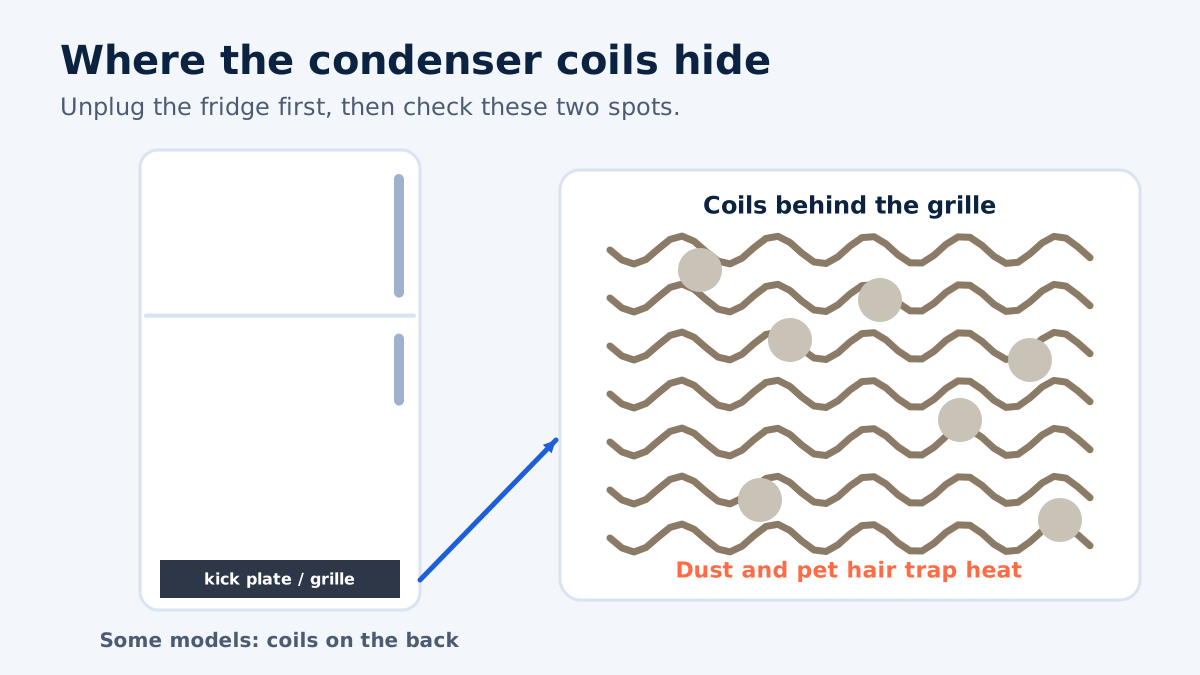
To clean them, unplug the fridge first. Pull off the grille and vacuum the coils with a brush attachment, then use a long coil brush for the tight spots. Do this about every six months, and more often if you have pets.
Cedar Rapids adds one more reason: our humid July and August days make coils work harder, and a second fridge in a dusty basement or garage has it worst.
Call a pro if: The coils are clean and the fridge still runs hot.
4. A Worn or Dirty Door Seal (DIY Check)
What you’ll notice: Frost near the door, water drops on the outside, or a door that doesn’t snap shut.
Try the dollar bill test. Close the door on a dollar bill, and if it slides out with no drag, the seal is leaking cold air. Test a few spots around the door, because seals wear unevenly.
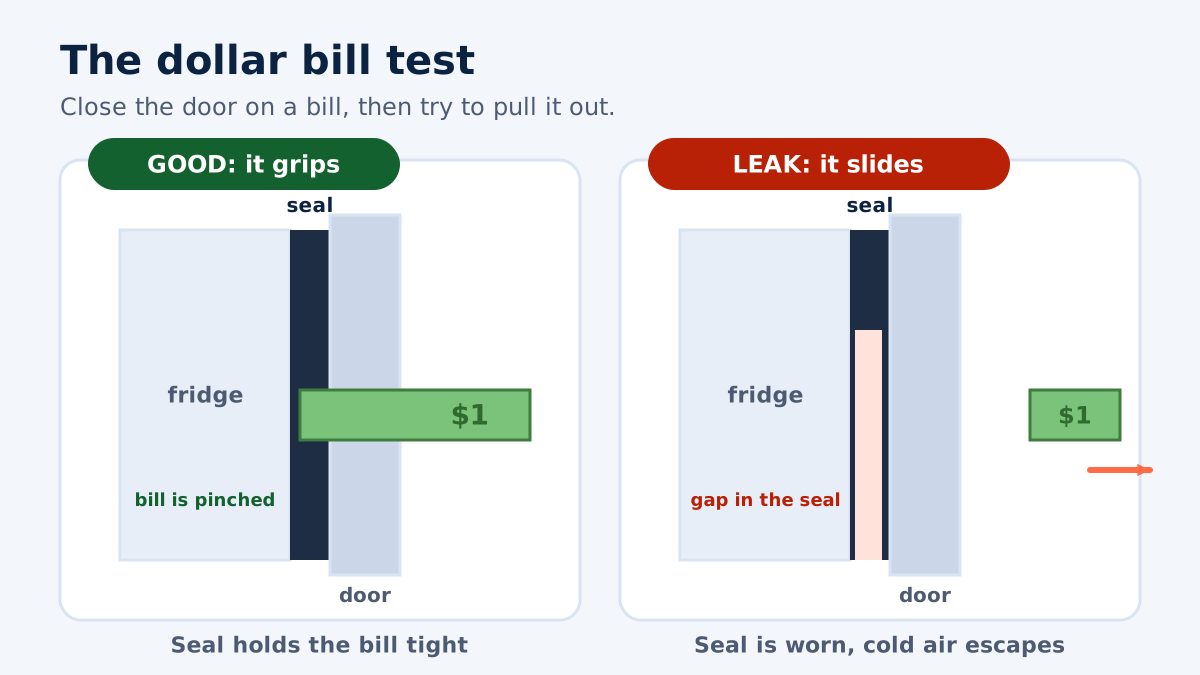
Start by cleaning the seal with warm, soapy water, since food residue can keep it from sealing. If it’s cracked or torn, replace it. Replacement seals usually run about $25 to $85, depending on the model.
Call a pro if: You’d rather not replace it yourself, or a new seal doesn’t fix it.
5. A Fan Has Quit (Pro)
What you’ll notice: The freezer is cold but the fridge is warm. You hear squealing or chirping, or you hear nothing where there should be a hum.
Your refrigerator has two fans. The condenser fan cools the coils near the compressor, and the evaporator fan sits behind the freezer’s back panel and pushes cold air into the fridge. When the evaporator fan quits, the freezer stays cold and the fridge warms up, which is the classic sign.
With the fridge unplugged, you can look for dust or debris around the condenser fan. The evaporator fan sits behind a panel and its blades can hit ice, so leave that one to a technician.
Call a pro if: You hear squeals or chirps, or the freezer is cold and the fridge isn’t.
6. The Defrost System Stopped Working (Pro)
What you’ll notice: A thick sheet of ice on the back wall of the freezer. The fridge is warm.
Your fridge melts away frost on its own, using a defrost heater, a defrost thermostat, and a defrost timer or control board. If one of those parts fails, frost builds up on the evaporator coils behind the freezer’s back panel and chokes off the airflow.
You can unplug the fridge for about 24 hours to melt the ice, but move your food into coolers first. That often brings the cold back for a while, though the frost returns if a part has failed. Never chip at the ice with a knife or an ice pick, because one slip can puncture a refrigerant line.
Call a pro if: The ice comes back.
7. The Compressor, Start Relay, or Control Board (Pro Only)
What you’ll notice: A click, a buzz, and another click, then silence. It repeats every few minutes. Or the fridge runs nonstop and never gets cold. Or you hear a loud knock.
The compressor is the pump of the cooling system. The start relay gives it the push it needs to start, and a thermal overload protector shuts it off if it gets too hot. The control board is the brain, and a small sensor called a thermistor tells the board how warm the fridge is. When any of these parts fails, your refrigerator can’t hold a steady temperature.
This is not a DIY job. If refrigerant is leaking from the sealed system, the repair needs special tools and a technician with EPA 608 certification. Own a Sub-Zero? Those need extra care, so see our Sub-Zero refrigerator repair page.
Refrigerator Not Cold, but the Freezer Is Fine?
That usually points to an airflow problem, not a cooling problem. The freezer makes the cold, and a fan, a vent, or a small door called a damper moves some of it into the fridge side.
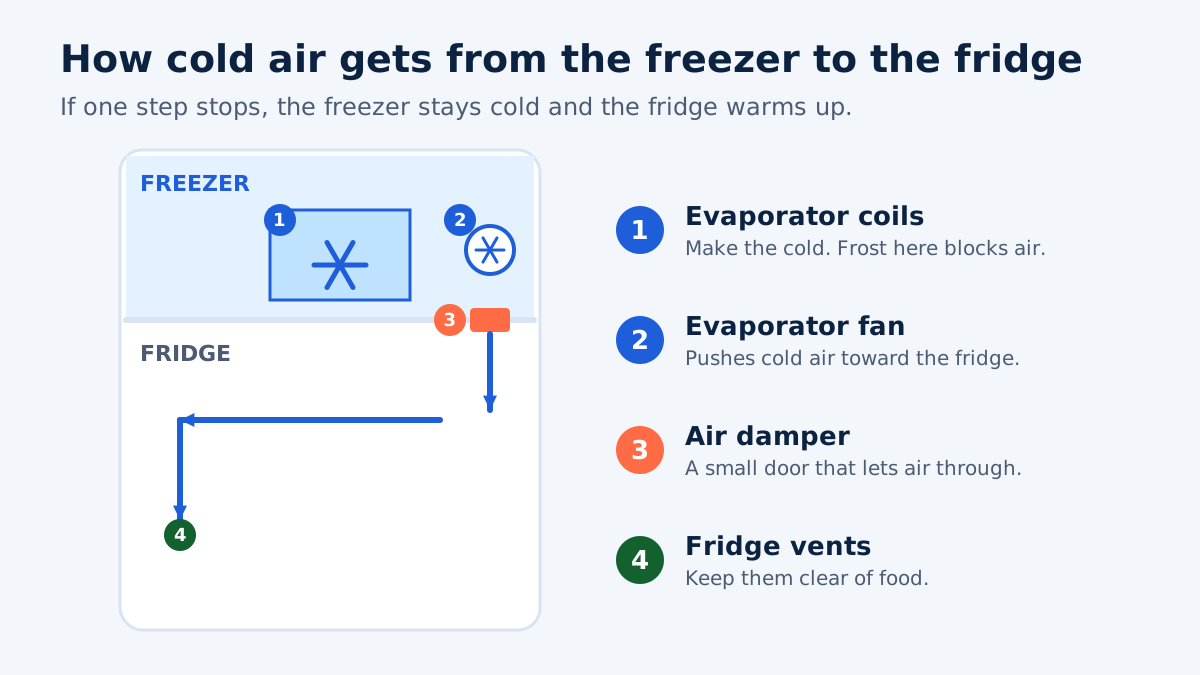
The usual suspects are these:
- A dead or iced-over evaporator fan (cause 5)
- Frost blocking the evaporator coils (cause 6)
- A stuck air damper that won’t open
- A bad thermistor that sends the wrong reading
- A failing control board
For a quick check, open the freezer and look at the back wall, since heavy frost means the defrost system is struggling. Then make sure no food is blocking the vents. If both look fine, it’s time to call. If your freezer is the one acting up, our freezer repair page covers that side.
Quick Guide: What You See and What It Means
| What you notice | Likely cause | DIY or call? |
|---|---|---|
| The fridge is silent and the light is off | Power, breaker, or outlet | DIY |
| The display is on but nothing is cooling | Demo mode (some models) | DIY |
| It hums, the freezer is cold, the fridge is warm | Evaporator fan, frost, or a stuck damper | Call |
| Thick ice on the freezer’s back wall | Defrost system | Call |
| It runs nonstop and the coils are dusty | Dirty condenser coils | DIY |
| A dollar bill slides out of the closed door | Worn door seal | DIY or call |
| Click, buzz, click, then silence | Start relay or compressor | Call |
| Warm everywhere and a loud knock | Compressor or sealed system | Call |
When Should You Call a Technician?
Call if any of these sound like your fridge:
- You did the easy checks and it’s still warm after 24 hours.
- It clicks and hums but never settles down.
- Thick ice keeps coming back.
- The breaker trips.
- You smell something burning.
- The fix means taking off a panel or touching the sealed system.
Please don’t open refrigerant lines, pull panels while the fridge is plugged in, or poke at ice with sharp tools. Swapping parts yourself can also affect your warranty on some models.
In most cases we can come out the same day. Call us and you’ll get a real answer on timing, not a maybe. You can see what a visit involves on our refrigerator repair in Cedar Rapids page.
What Does It Cost to Fix a Refrigerator That Isn’t Cooling?
Cost depends on the part, the brand, and the labor. HomeAdvisor’s national numbers, updated in November 2025, put a typical fridge repair at $200 to $1,300, with an average near $650. Technicians charge about $45 to $120 an hour. Those are national figures, not our prices. In general, cleaning coils or replacing a door seal sits at the low end. A sealed-system or compressor job sits at the high end.
This is how we do it: we tell you the diagnostic fee before we come out, and you get the price before we start any work. It’s all backed by our repair guarantee.
Is it worth fixing? A common rule says that if the repair costs close to half the price of a new fridge, replacing usually makes more sense. Age matters too. Most fridges last 10 to 15 years. A control board on a four-year-old fridge is usually worth fixing. A failed compressor on a 13-year-old fridge is a different conversation. Our cost guide and our repair or replace guide break it down.
Fridges That Quit in Cedar Rapids
Our weather and our houses are hard on fridges, so here’s what matters most around here.
Humid summers. July and August heat makes your fridge work overtime, and a layer of dust on the coils can push it over the edge.
Basement and garage fridges. Plenty of older homes around Czech Village and Wellington Heights run a second fridge in the basement. It’s warm, dusty, and cramped down there, which is rough on coils and compressors. Very hot or very cold rooms can also throw a fridge off, which is why a garage fridge can struggle in an Iowa winter.
Storms and outages. If you were here for the August 2020 derecho, you remember how fast a stocked fridge becomes a problem when the power is out for days. Keep the doors shut, put a thermometer inside, and keep a cooler and ice handy. When the power comes back, check the temperature before you trust what’s inside. Some fridges also need up to 24 hours to settle down.
We fix fridges all over Cedar Rapids, from Kingston Village and NewBo to Bever Park and the neighborhoods near Coe College. We also cover Marion, Hiawatha, Robins, and Fairfax.
Frequently Asked Questions
How do you fix a refrigerator that is not cooling?
What is the most common fridge failure?
Why is my refrigerator not cooling but the freezer works?
How do I reset a refrigerator compressor?
What can cause a fridge to not be cold?
How can I tell if the compressor is bad?
How long can food stay in a fridge that isn’t cooling?
Is it worth fixing a refrigerator that isn’t cooling?
Still Warm? Call Us
If your fridge is still not cooling after these checks, we can help. Tell us what you hear and see. You’ll get a straight answer on timing, cost, and whether the repair is worth it.
Prefer to read first? See our refrigerator repair service page.