Dryer Not Heating? 7 Causes and the Vent Check That Fixes Most
Quick Answer
If your dryer spins but the clothes come out damp and cool, start with two things: the lint screen and the vent. A clogged vent is the most common reason a dryer stops heating, and it is also a fire risk if you ignore it. The second thing to check is the breaker. An electric dryer needs two breaker poles to heat, and if one trips the drum will still turn.
This guide is for Cedar Rapids homeowners with a dryer that is not heating. It walks through seven causes in the order a technician would check them, tells you which ones are safe to handle yourself, and shows when it is time to stop and call. We have kept the technical parts plain, because most people only need to know what is wrong and what it will take to fix it.
Safety first. Unplug the dryer before you touch anything behind or inside it. If you smell burning, see scorch marks, or notice the cabinet is unusually hot, stop using the dryer and call a pro. If you have a gas dryer and smell gas, leave the house and call your gas utility. Never work on a gas line yourself.
In this guide
- Quick checks before you call anyone
- Why it runs but does not heat
- Breaker or 240-volt power
- Clogged lint screen or vent
- Blown thermal fuse
- Failed heating element
- Thermostat or thermistor
- Control board or timer
- Gas igniter or valve
- What you see and what it means
- Dryers in Cedar Rapids homes
- DIY fix or call a pro?
- Repair or replace?
- Frequently asked questions
Quick checks before you call anyone
These four checks take about ten minutes and fix a surprising share of no-heat problems. Do them in this order.
Why is my dryer running but not heating?
A dryer needs three things to dry clothes: power, heat and airflow. The drum motor and the controls run on regular 120-volt power, which is why the drum can keep turning even when the heat is gone. The heating part of an electric dryer runs on 240 volts, so it can fail on its own. And without airflow, even a working heater shuts itself off to protect the machine.
That is why a dryer that is running but not heating usually comes down to one of three things: the heat never gets power, the heat part has failed, or a safety device has cut the heat because air could not get out.
Gas dryers work the same way, with one difference. Instead of a heating element they use a gas valve and an igniter to make a flame. They still need 120 volts for the drum and controls, so a gas dryer can also spin without heating. The causes below mark which ones apply to electric dryers, gas dryers, or both.
7 causes of a dryer not heating
We have ordered these from most common and easiest to check, to least common and technician-only. Each one is tagged DIY check or Pro repair so you can see at a glance where your own part ends.
1. A tripped breaker or a 240-volt power problem (DIY check)
An electric dryer pulls power through two lines at once. If one half of the double-pole breaker trips, the drum motor still gets 120 volts and runs, but the heating element gets no 240-volt supply and stays cold. The same thing can happen with a loose plug or a worn power cord.
What to do: reset the breaker once, as described above, and make sure the plug is pushed all the way into the outlet. If the breaker trips again, do not keep resetting it. A breaker that keeps tripping is telling you something is wrong, whether in the dryer, the cord or the wiring, and that needs a technician or an electrician.
2. A clogged lint screen or dryer vent (DIY check)
This is the cause to rule out first, and the one most people skip. Lint builds up in the exhaust duct behind the dryer, in the wall, and at the vent hood outside. When air cannot leave, the drum gets hotter than it should, and the safety devices shut the heat off. Clothes stay damp, the dryer runs hotter on the outside, and the next cycle is worse.
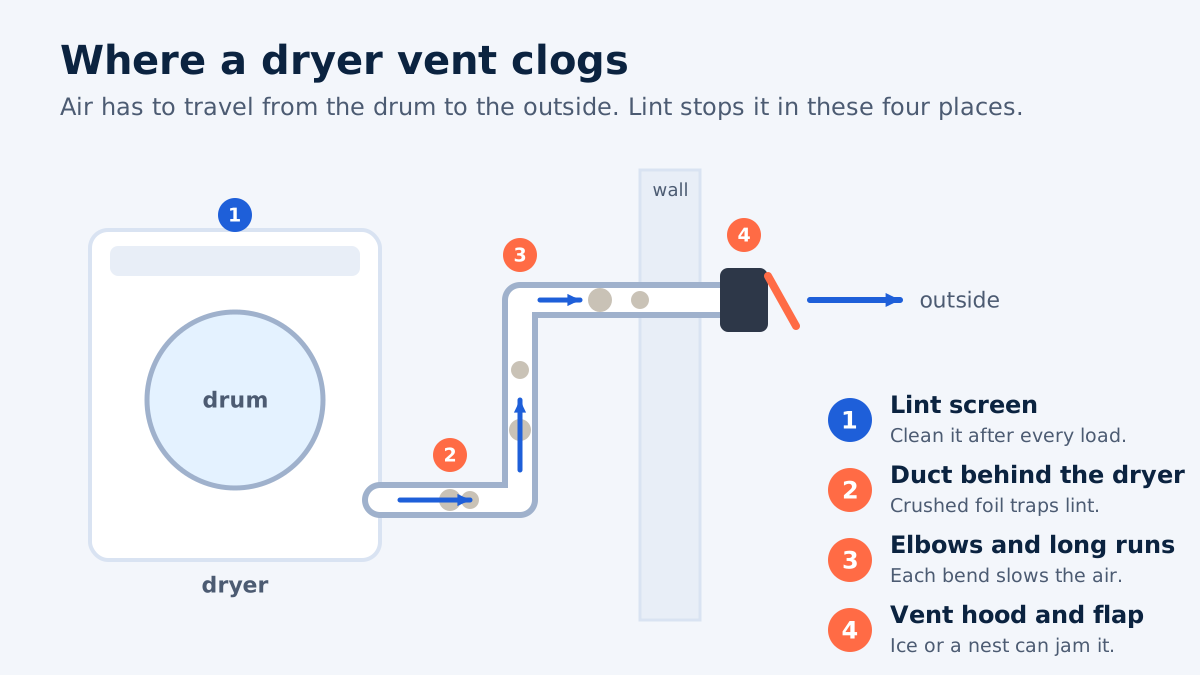
Signs of a blocked vent:
- Clothes need two cycles to dry
- The top of the dryer or the laundry room feels hot
- A musty or hot smell
- Very little air at the outside vent hood
How to clear it: unplug the dryer, pull it away from the wall, and disconnect the duct. Use a vent brush and a vacuum to clear the duct and the opening on the back of the dryer. Then clear the vent hood outside. Replace any crushed or kinked foil duct with rigid or semi-rigid metal duct, which holds its shape and gives lint less to catch on. Check your dryer manual for the maximum vent length, since long runs with many elbows clog faster.
If the vent runs through a wall or roof and you cannot reach it, a professional vent cleaning is worth it. A blocked vent is a fire risk, so do not keep running the dryer while you wait.
3. A blown thermal fuse (Pro repair)
The thermal fuse is a small safety part that blows when the dryer overheats. It is usually the result of the blocked vent described above. Once it blows, it cannot reset. Depending on the model, a blown fuse can mean no heat or a dryer that will not start at all.
The fuse itself is cheap, but replacing it without fixing the vent is a mistake. The new fuse will blow again, and you will have paid for the same repair twice. A technician will test the fuse with a multimeter, replace it, and check the airflow before leaving.
4. A failed heating element (Pro repair, electric dryers)
The heating element is a coil of wire that glows when current passes through it. Over years of heating and cooling it can crack or burn through, and then the dryer runs with no heat at all. This is one of the most common true failures on an electric dryer, but it is also the one people blame too early, before checking the vent and breaker.
You cannot see most breaks by eye. A technician switches the power off, tests the element for continuity with a multimeter, and replaces it if the circuit is open. Because the part sits next to live wiring and sharp sheet metal, we do not recommend opening the cabinet yourself. We repair Maytag dryers, among other brands.
5. A faulty thermostat or thermistor (Pro repair)
Dryers use thermostats or a temperature sensor called a thermistor to keep the drum at the right heat. A cycling thermostat switches the heat on and off. A high-limit thermostat cuts the heat if the dryer runs too hot. When one fails, you may see heat that cuts out early, heat that never reaches temperature, or a dryer that works on one setting and not another.
These parts are hard to judge by feel, and they are often the downstream victim of a blocked vent. A technician tests each one and checks the airflow so the new part does not fail the same way.
6. A control board or timer fault (Pro repair)
The timer or electronic control board tells the heating element when to turn on. When it fails, it may not send that signal, so the drum turns but the heat stays off. This is a less common cause, and a technician should rule out the fuse, thermostats and element before replacing a board, because it is usually the most expensive part on the list.
If your dryer shows an error code, write it down before you call. It narrows the search a lot.
7. A gas dryer igniter or gas valve (Pro repair, gas dryers only)
On a gas dryer, the igniter has to glow hot enough to open the gas valve and light the burner. A weak igniter is a very common reason a gas dryer spins without heating. The valve coils that open the gas flow can also wear out.
This is not a DIY repair. It involves the gas supply and a flame, and a mistake is dangerous. If you smell gas at any point, leave the house and call your gas utility before anyone touches the dryer.
What you see and what it usually means
Use this table to match your symptom to the most likely cause. It points you to the right section above.
\n| What you notice | Most likely cause | Your next step |
|---|---|---|
| Clothes need two cycles, laundry room feels hot | Clogged vent or lint screen | DIY check |
| Drum spins, no heat, breaker tripped | Power or 240-volt problem | Reset once, then call if it trips again |
| Drum spins, no heat, vent is clear | Thermal fuse, heating element or thermostat | Pro repair |
| Heat starts, then cuts out | Thermostat or thermistor | Pro repair |
| Dryer will not start and has no heat | Thermal fuse or control board | Pro repair |
| Gas dryer spins but never gets warm | Igniter or gas valve | Pro repair only |
| Burning smell or very hot cabinet | Blocked vent and overheating | Stop using it and call |
Why dryers struggle in Cedar Rapids homes
Some no-heat problems have a local side. A few conditions here are worth knowing about before you start troubleshooting.
- Cold garages and basements. Many dryers in Iowa homes sit in an unheated garage or basement. Air that starts out very cold takes longer to heat up, and many manufacturers list a minimum room temperature in the manual. If the room is colder than that, drying slows down even when nothing is broken. Check your manual.
- Winter vent problems. Snow, ice and nests can jam the flap on an outside vent hood. Warm, damp air also cools as it travels through a cold wall or crawl space, which leaves lint and moisture in the duct and makes clogs form faster.
- Long or older vent runs. Many older homes have a dryer on one side of the house and a vent run of many feet, with elbows, to reach the outside. The longer and twistier the path, the more often it needs cleaning.
If your dryer is in a cold space and clothes seem to take longer in winter, clean the vent first, then see whether moving the dryer to a warmer room is an option.
DIY fix or call a pro?
The line is simple. Anything outside the cabinet, such as the lint screen, the vent duct, the vent hood and one breaker reset, is a reasonable DIY job if you unplug the dryer first and are comfortable moving it. Anything inside the cabinet is a technician’s job. That includes the thermal fuse, the heating element, thermostats, the control board, and everything on a gas dryer.
Call for dryer repair in Cedar Rapids if:
- The vent is clean and the breaker is fine, but there is still no heat
- The breaker trips again after you reset it
- You smell burning or see scorch marks
- You have a gas dryer and the heat will not start
- The dryer shows an error code you cannot clear
We tell you the diagnostic fee before we come out, and you get the price before we start any work. It is all backed by our repair guarantee. If you want to know what to expect, our appliance repair cost guide explains how repair pricing works.
Is it worth repairing, or should you replace the dryer?
Most no-heat problems are repairable, and a fuse, an element or an igniter is a much smaller bill than a new dryer. Replacement starts to make sense when the dryer is old, when more than one major part has failed, or when the repair would cost close to half the price of a new machine. Our repair or replace guide walks through how to decide.
If your washer is acting up at the same time, it is worth having both checked in one visit.
Dryer Not Heating FAQ
Why is my dryer running but not heating?
Why is my dryer blowing cold air?
How do I know if the thermal fuse is blown?
Can a clogged vent stop a dryer from heating?
Why does my dryer take two cycles to dry?
Is it safe to keep using a dryer that is not heating?
How often should I clean the dryer vent?
Is it worth fixing a dryer that is not heating?
Need Help With a Dryer That Is Not Heating?
If you have checked the vent and the breaker and the dryer still will not heat, call Cedar Forge Appliance Repair at (319) 432-7410. We repair dryers in Cedar Rapids, Marion, Hiawatha, Robins and Fairfax, and most repairs are completed the same day.